The Thirty Percent Line: Highline Commerce Puts Wall-Powered Humanoids on Brooklyn Fulfillment
Highline Commerce reports Ultra Robotics OP1 humanoids handle up to 30 percent of pick-tote-scan workflows in live Brooklyn 3PL production — a mid-market milestone outside Amazon's ecosystem.
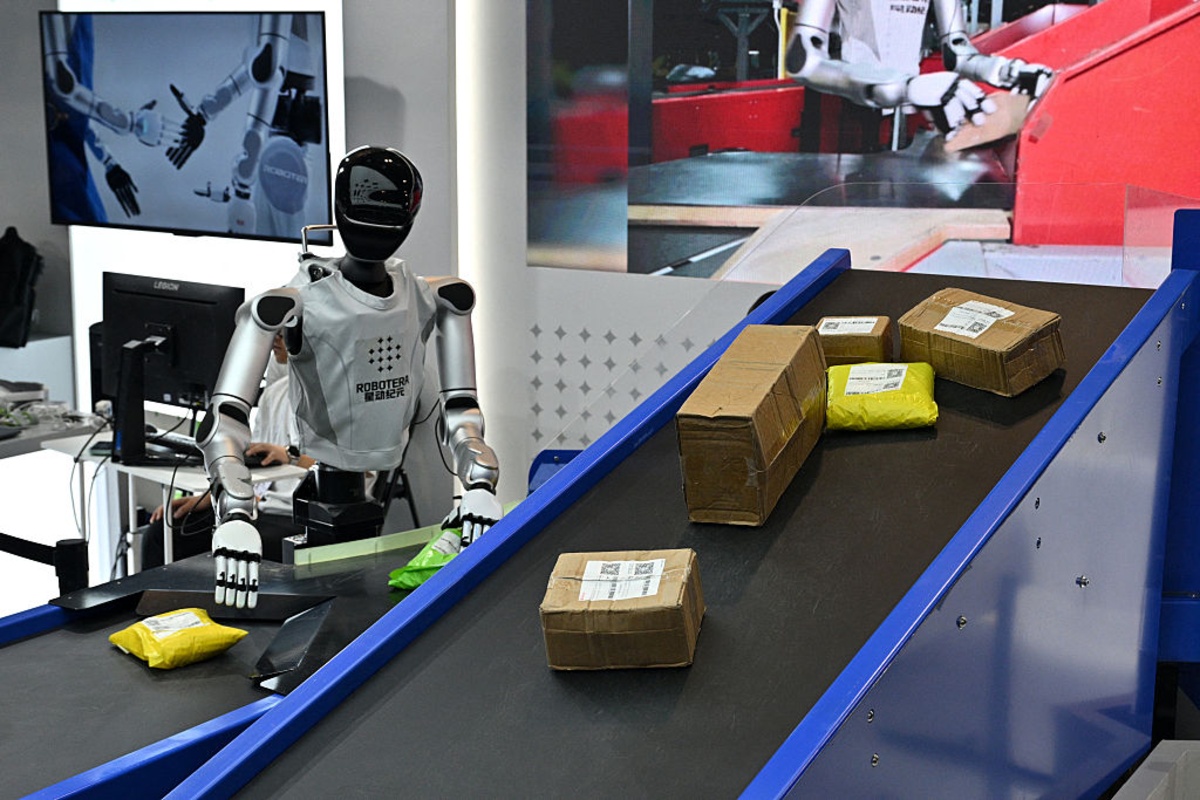
Humanoid robotics has produced plenty of demo videos and enterprise pilot announcements. What it has lacked, until recently, is a mid-market third-party logistics operator willing to publish a specific, sustained task-share number from live commercial production.
On July 23, Highline Commerce said its humanoid fleet from co-tenant Ultra Robotics is filling up to 30 percent of client orders at its 60,000-square-foot facility in Brooklyn's Industry City campus. That figure covers the pick, tote, scan, and conveyor workflow — not a curated pilot, but ongoing 24/7 production serving more than 200 direct-to-consumer brands.
Why this deployment is structurally different
Previous commercial humanoid milestones arrived through closed enterprise ecosystems. Agility Robotics' Digit moved more than 100,000 totes for Amazon and GXO Logistics. Figure AI's Figure 02 supported BMW X3 production at a Spartanburg plant. These are real achievements — but they came through purpose-built partnerships, dedicated robotics budgets, and enterprise procurement pipelines.
Highline got here by sharing a building with its robotics vendor.
Ultra Robotics, a Y Combinator-backed team based in New York City, is also an Industry City tenant. The two companies began an alpha design partnership in 2025, testing robots in live Highline production runs rather than in a controlled lab. By mid-2026, the relationship had graduated to commercial production. No seven-figure enterprise contract. No dedicated integration team. The entry cost was a commercial lease on the same 35-acre campus.
TechTimes reported that this co-location model removes a friction that has slowed humanoid deployment at mid-market operators: the distance between the robot's development team and the operator's production floor.

What the OP1 actually does — and what it does not
Ultra Robotics' Operator OP1 is not a walking bipedal humanoid. It is a stationary dual-arm robot mounted on a fixed base with locking caster wheels. At roughly 180 centimeters tall and 140 kilograms, it has 14 degrees of freedom and two-finger grippers carrying up to 5 kilograms per arm.
The OP1 does not navigate warehouse aisles or climb stairs. It handles manipulation tasks inside a fixed 10-by-10-foot work cell. RGB cameras feed an onboard vision-language-action neural network that outputs joint and gripper commands at 10 Hz. Training runs on teleoperation data; when one robot masters a new item type, that knowledge propagates across the Ultra fleet through what the company calls fleet AI.
The power architecture is what makes 24/7 operation practical at commercial scale today. The OP1 plugs into a standard 120-volt outlet. No battery to charge. No scheduled downtime. The tradeoff is explicit: eliminate mobility, eliminate the energy constraint — but accept a bounded work cell.
What "30 percent" actually means
The 30 percent figure is specific in a way most humanoid benchmarks are not. It applies to Highline's linear fulfillment pipeline within a DTC e-commerce operation with a relatively consistent product mix — conditions where the OP1's gripper design and training approach work well.
TechTimes noted that other operators running humanoids in higher-SKU environments report platforms reliably handling roughly 5 percent of a 100,000-SKU product universe. Highline's 30 percent reflects genuine commercial production in a favorable operating context, not a general statement about humanoid capability across all warehouse tasks.
The remaining 70 percent of orders involve item types, packaging configurations, or handling requirements that current platforms do not yet reliably manage at speed.

The economics
At an estimated price around $80,000 per unit, the OP1 sits in the middle of the commercial humanoid range. Robots-as-a-service pricing from comparable 2025-scale deployments runs approximately $8 to $15 per hour, against U.S. warehouse wages of roughly $20 to $25 per hour.
Highline founder and CEO Richard Hurley told TechTimes that the co-location model made the partnership viable: "None of that could happen in Silicon Valley, where the real estate alone would price everyone out."
Industry City's campus houses more than 700 businesses with manufacturing-grade infrastructure — oversized freight elevators, three-phase industrial power, and enterprise connectivity. The model is replicable wherever logistics operators and robotics teams share physical proximity and order mixes favor bounded manipulation tasks.
What the industry still cannot answer
The Highline deployment does not yet prove that co-location scales beyond purpose-built campuses, or that humanoid task-share rises as SKU diversity grows. Independent analyst timelines still place meaningful workforce impact from warehouse humanoids in the 2027 to 2030 window.
What it does prove is narrower and still important: a mid-market 3PL outside the Amazon and automotive ecosystems is shipping real orders with humanoid systems at a documented 30 percent task share, running around the clock on wall power, with the engineering team next door.
For the roughly 15,000 independent 3PL operators in the United States watching from the sidelines, that is the clearest commercial signal yet.
Sources
- TechTimes — Humanoid Robots Hit 30% Order Fill at Brooklyn 3PL Outside the Amazon Ecosystem (July 23, 2026)
- TechTimes — Humanoid Robot IPO: Agility Robotics Signs SPAC Deal for US Nasdaq Debut (referenced within July 23, 2026 coverage)