The Cryogenic Controller: HRL's Self-Operating Silicon QPU Runs Error Correction in Nature
HRL's Nature paper describes a silicon QPU with an integrated 4 K CMOS controller that autonomously runs quantum error correction — no real-time room-temperature control required.
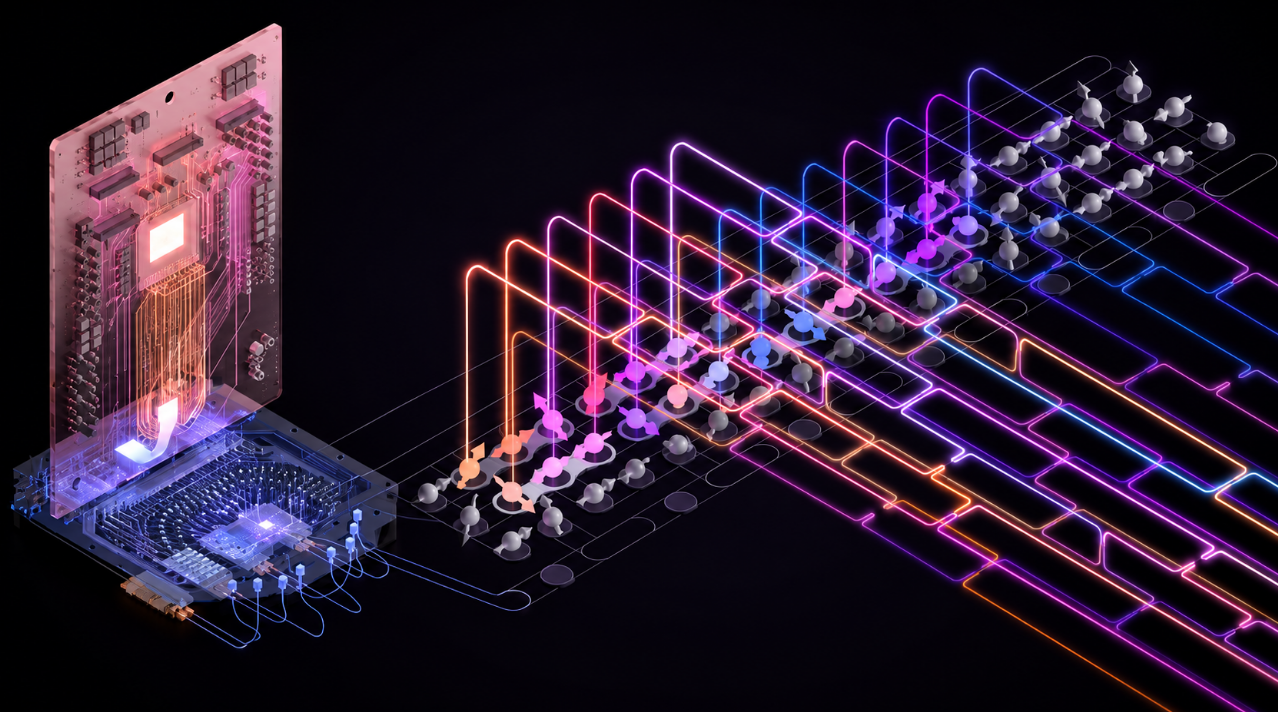
Quantum computers still depend on room-temperature electronics to generate nearly every control pulse sent to qubits millikelvin above absolute zero. That wiring bottleneck — thermal load, latency, and physical complexity — is one of the least glamorous barriers to scaling.
On July 29, 2026, HRL Laboratories published a result in Nature that attacks it directly: a digitally controlled silicon quantum processing unit (QPU) that autonomously executes quantum error correction without real-time room-temperature control during the correction loop.

What HRL built
The system integrates three fabricated components:
- 18-qubit silicon spin processor — exchange-only qubits fabricated with a process HRL says reduced charge noise tenfold versus prior gate electrode designs
- Custom cryogenic CMOS controller at 4 K — generates all time-varying qubit control signals inside the cryostat
- Superconducting ribbon cable — routes signals to the millikelvin stage while acting as a thermal standoff
Room-temperature connections are limited to digital communication, qubit readout, and static biases — not per-gate analog waveform generation.
Error correction results
HRL verified the QPU on codes designed for fault tolerance:
- [3,1,3] and [5,1,5] repetition codes with repeated syndrome measurements
- [[4,2,2]] quantum error-detecting code across six physical qubits
Key reported metrics:
| Metric | Value (HRL / Nature) |
|---|---|
| Single-qubit gate error | 1.7 × 10⁻⁴ average |
| CNOT entangling error | 3.5 × 10⁻³ average; 9 × 10⁻⁴ best reproducible |
| Distance-5 error suppression | Λ₅/₃ = 4.7 scaling factor |
| [[4,2,2]] logical fidelity | 95% across three syndrome rounds |
| Gate speed | Sub-microsecond operations |
Errors fell roughly fivefold when the team expanded from a distance-3 to a distance-5 repetition code — the error-suppression property fault-tolerant quantum computing requires.
Why cryogenic control matters
Every external control line into a dilution refrigerator adds heat. Racks of arbitrary waveform generators at room temperature also add latency — problematic when error correction must react within coherence times.
HRL's claim is architectural: move the control intelligence to 4 K, keep the quantum chip colder, and use a manufacturable wafer-process ribbon to bridge the gap. Exchange-only qubits help because their control waveforms resemble standard digital pulses — compatible with power-constrained CMOS.
This is, per HRL's press materials, the first demonstration of error correction executed entirely by a cryogenic controller with no real-time room-temperature involvement in the correction loop.

Industry context
HRL is jointly owned by Boeing and General Motors. The Nature publication arrives as IBM has announced its definitive agreement to acquire HRL Laboratories — positioning this cryogenic CMOS and silicon spin expertise inside IBM's broader quantum roadmap.
What remains open
Eighteen qubits is a benchmark scale, not a utility-scale machine. The Nature paper's value is architectural proof — that a foundry-fabricated cryogenic controller can run real error-correction routines with measured suppression — not qubit count leadership.
Sources
- A digitally controlled silicon quantum processing unit — Nature (July 29, 2026)
- HRL Shows Self-Operating Silicon Quantum Processor — The Quantum Insider
- HRL Laboratories Demonstrates Self-Running Silicon QPU — Quantum Computing Report
- A digitally controlled silicon quantum processing unit — arXiv:2604.16216