The Explorer and the Late Landing: Google DeepMind Maps Why Reasoning Models Overthink
A Google DeepMind ACL 2026 study introduces TRACE, a structural analyzer that decomposes chain-of-thought traces into sub-thought graphs—and finds that over-verification and over-exploration, not raw length, drive most wasted inference on simple queries.
The question behind the headline
When Anthropic shipped Claude Opus 5 on July 24, 2026, one of the product storylines was efficiency: a model that could approach frontier-tier performance without burning tokens the way dedicated reasoning models often do. That launch landed in the middle of a broader industry argument—not about whether chain-of-thought reasoning helps on hard problems, but about why models keep reasoning long after the answer is already in view.
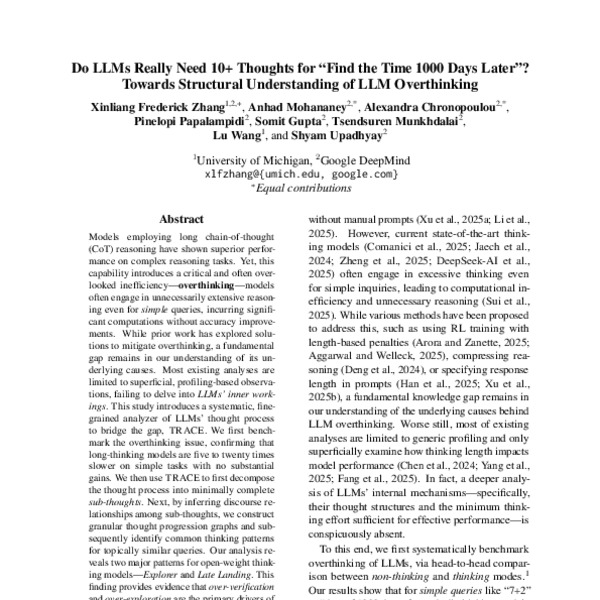
Google DeepMind researchers now offer a structural answer. In a paper presented at ACL 2026 in San Diego—titled Do LLMs Really Need 10+ Thoughts for “Find the Time 1000 Days Later”? Towards Structural Understanding of LLM Overthinking—a team led by Xinliang Frederick Zhang (University of Michigan and Google DeepMind) introduces TRACE, a Thought-process Reconstruction and Automated Clustering Engine. Rather than counting tokens to the first correct answer, TRACE decomposes a model’s reasoning trace into minimally complete sub-thoughts, infers discourse relationships between them, and builds progression graphs that reveal how a model arrived at (or wandered away from) a solution.
The headline example is deliberately mundane. A date-arithmetic query like “What is the time 1,000 days after today?” should not require a dozen verification loops. Yet open-weight thinking models routinely produce them—and pay for it at inference time.
Benchmarking the waste before dissecting it
Before TRACE enters the picture, the authors establish the scale of the problem with a controlled horizontal and vertical benchmark.
Horizontal sweep. The team evaluates 14 thinking models spanning the Qwen3 family (0.6B through 235B parameters) and DeepSeek-R1 distilled variants built on Qwen2.5 and Llama-3 backbones (1.5B through 70B). They compare each model’s thinking mode against its non-thinking mode across six datasets grouped into two domains:
- Simple reasoning: ASDiv grade-school math, date arithmetic, Zebra logic puzzles
- Knowledge recall: SQuAD 2.0 (including unanswerable questions), NIAH long-context fact retrieval, SimpleQA
The headline finding from this phase is blunt: on simple queries that non-thinking models already solve correctly, enabling thinking makes models five to twenty times slower, with little or no accuracy gain. For simple reasoning tasks, additional thinking stops being effective once model scale crosses roughly 4–8 billion parameters—beyond that threshold, the performance gap between modes largely collapses. On knowledge-recall tasks, thinking provides negligible benefit regardless of scale.
Vertical sweep. The researchers then tighten the lens on mathematical and temporal reasoning with graded difficulty. On ASDiv levels 1–5 and GSM8k, thinking helps more as problems get harder—but at a steep cost. On GSM8k, Qwen3-235B-A22B uses more than 10× the thought tokens while roughly 80% of that extra compute yields no measurable performance improvement. Temporal reasoning tells a different story: at low difficulty levels, non-thinking models already score near-perfect; at higher levels requiring day-level counting across hundreds or thousands of days (with leap-year and calendar-system edge cases), thinking performance collapses despite massive token spend—a ceiling imposed by representational capacity, not effort alone.
These results align with prior length-based overthinking studies, but the authors argue length alone explains too little. That is where TRACE begins.
Inside TRACE: from sub-thoughts to progression graphs
TRACE operates in four stages:
- Response sampling from large thinking models (Qwen3-30B-A3B, Qwen3-32B, R1-Distill-Llama-70B, Qwen3-235B-A22B)
- Thought decomposition and label inference, using Gemini 2.5 Pro to split traces into self-contained, answer-bearing sub-thoughts and assign relational labels (Initial, Verify, Correction, Backtrack, Branch Out, Sidetrack, Final)
- Progression graph construction, where nodes represent distinct proposed answers and edges encode transition types
- Thought pattern induction via clustering of graphs from topically similar queries
Human inspection on 200 randomly sampled sub-thoughts found automatic labels reasonable 93% of the time—a detail that matters because the entire structural analysis rests on label quality.

Two patterns, two failure modes
Aggregating thousands of progression graphs, the team identifies two dominant patterns whenever models generate at least three intermediate answers:
The Explorer. Correctness probability is spread across many nodes. The model may land on the right answer early, then keep branching into alternative approaches—over-exploration. Visually, the graph fans out; backtracking edges appear frequently. Performance can peak early while token spend keeps climbing.
The Late Landing. Reasoning follows a more linear path; correctness probability concentrates at the terminal stage. The model converges, then loops on self-verification—over-verification. Qwen3-32B exemplifies this pattern in the paper’s temporal-reasoning analysis, with thick self-loops at the end of traces.
Both patterns waste compute, but for different structural reasons. Length-based metrics treat them identically. TRACE does not.
A utility-based definition—and why it matters now
The paper’s central conceptual contribution is a structure-based definition of overthinking: reasoning that continues after the marginal return—ΔPerformance / ΔThought—falls below a predefined threshold ε. The point where returns diminish sharply is the convergence point; everything after it is overthinking in a principled sense, not merely “more tokens than necessary.”
This reframing has immediate engineering implications:
- Early stopping could be pattern-aware: Explorer traces might benefit from halting once a high-confidence answer stabilizes; Late Landing traces might need verification budgets rather than open-ended generation.
- Effort controls like those Anthropic exposes on Opus 5 become easier to interpret when tied to structural convergence rather than arbitrary token caps.
- Evaluation design should separate tasks where thinking pays (narrow middle ground on graded math) from tasks where it cannot (trivial recall, or problems beyond a model’s internal calendar arithmetic).
The authors are careful about scope. TRACE analyzes third-party open-weight thinking models—Qwen3 and DeepSeek-R1 distillates—not closed frontier systems. The patterns may not transfer one-to-one to every proprietary stack. Still, the timing is notable: as labs compete on “efficient frontier” positioning, a peer-reviewed tool for diagnosing why reasoning runs long is more actionable than another leaderboard point.
What TRACE does not claim
The paper is explicit about boundaries. It does not propose a single deployed mitigation product. It does not guarantee that stopping at the convergence point preserves accuracy on hard reasoning benchmarks. And it treats “simple” queries as those solvable by bright middle-school students—a pragmatic filter that excludes many real-world enterprise prompts.
What it does provide is a vocabulary. Overthinking is not one phenomenon; it is at least two, driven by exploration and verification habits baked into RL-trained reasoning models. Until teams can see those habits in the trace, token caps will remain a blunt instrument.
For a field racing toward longer horizons—multi-hour agents, autonomous research loops, coding sessions that span repositories—the difference between useful thinking and structural overthinking is quickly becoming an economics question. TRACE offers a map. The next step is building brakes that know which road they are on.
Sources
- Google DeepMind — Towards Structural Understanding of LLM Overthinking (July 2, 2026)
- ACL Anthology — Do LLMs Really Need 10+ Thoughts for “Find the Time 1000 Days Later”? Towards Structural Understanding of LLM Overthinking (July 2026)
- arXiv — Do LLMs Really Need 10+ Thoughts for “Find the Time 1000 Days Later”? (2510.07880) (2026)
- Anthropic — Introducing Claude Opus 5 (July 24, 2026)