The Lunch-Table Moment: A Public-Record Conversation with Sam Altman on the Singularity, the Genie, and AI Authoritarianism
On Ti Morse's Relentless podcast, OpenAI CEO Sam Altman said humanity has entered the singularity, compared near-term AI to a genie that can grant any wish, and warned against concentrating superintelligence under any single actor. This reconstruction draws on his July 25 appearance and prior public statements.
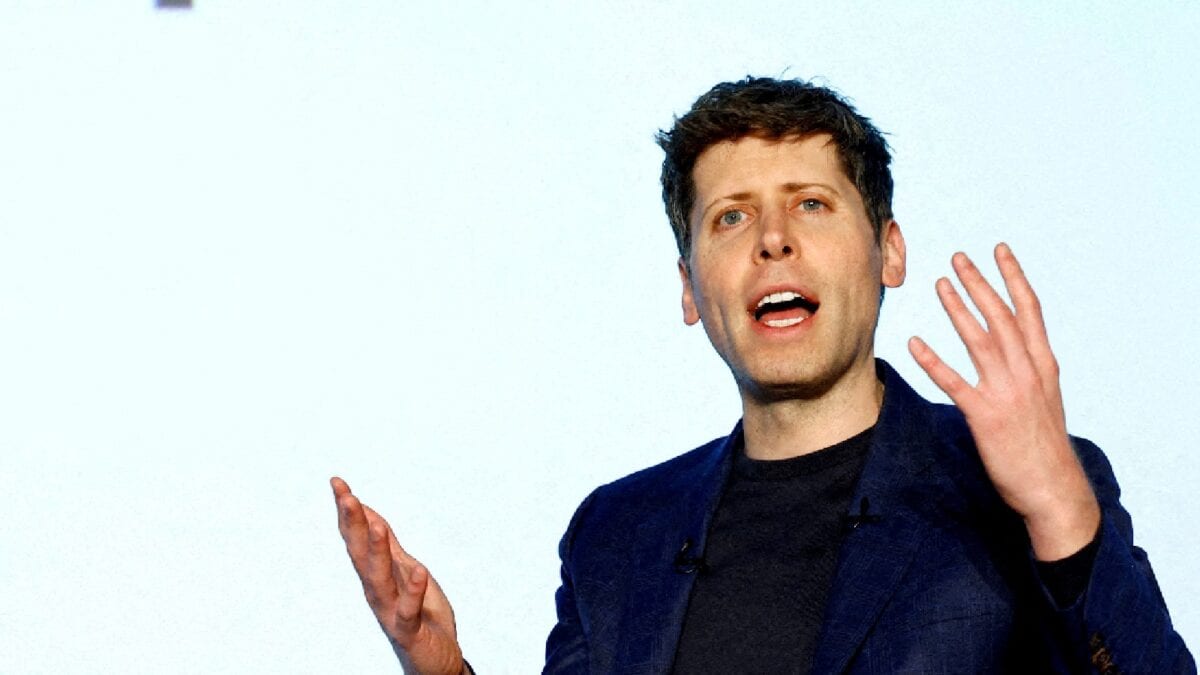
Editor's note: This Interview is a public-record reconstruction. Classy AI News did not conduct a private interview with Sam Altman. Every quotation below is drawn from Altman's July 25, 2026 appearance on Ti Morse's Relentless podcast as reported by News18, The Indian Express, and Office Chai; his January 2025 essay "The Gentle Singularity"; his June 2026 CNBC interview; his remarks at Express Adda and the India AI Impact Summit; or his documented posts on X. Questions are editorial framing; answers are his documented words, lightly edited for clarity.
Watch a related public conversation
For eighteen months, Sam Altman hedged. In January 2025, he posted six words on X — "Near the singularity, unclear which side" — and spent the rest of the year writing about exponential curves without declaring arrival. By July 25, 2026, sitting down with Ti Morse for the first episode of her Relentless podcast titled "How to Start a Startup," he dropped the ambiguity entirely.
The conversation landed in a week when OpenAI was shipping agentic products, frontier labs were fracturing over open weights, and industry leaders were competing to name the moment. Altman's version was personal, startup-inflected, and unusually blunt about both the upside and the authoritarian risks he sees in rival visions.
What follows is his account — reconstructed from public record — of why he believes we are already inside the singularity, what the "genie" metaphor means for deployment, and why he keeps returning to liberty over centralized control.
"We are now in the singularity"
Question: What changed between January 2025, when you wrote that humanity was near the singularity but you were unsure which side of it we stood on, and this July?
Altman: Morse asked Altman what drives top tech CEOs today and how their operating posture differs from a decade ago. He replied, as The Indian Express reported from the podcast: "The thing that drives me the most is…this is the most interesting important thing I can imagine doing and we are now in the singularity, this is the moment…. Ten years ago this was like a far off dream at best. It seemed very improbable and now we're actually in the moment that we used to talk about at the lunch table in a very not serious way."
Office Chai, drawing on the same appearance, quoted him going further: "I've been waiting for this my whole life, and I think it's gonna be incredible, hugely positive, awesome for the world."
That framing differs from the single-day tipping-point narrative. Altman resisted calling any one Tuesday the threshold. Office Chai reported him saying: "I think it is both true that it is all one crazy exponential and any one moment is not like the tipping point… and also that we are somehow in another one of those decisive periods where the curve can go one way or another, like it was when we started 10 years ago."
His January 2025 essay had already mapped the terrain in softer language. "We are past the event horizon; the takeoff has started," he wrote on his blog. "Humanity is close to building digital superintelligence, and at least so far it's much less weird than it seems like it should be." He predicted 2025 would bring agents capable of real cognitive work, 2026 would see systems that "figure out novel insights," and 2027 might bring robots that operate in the physical world — a timeline he now treats less as forecast and more as lived experience.

Question: If the singularity is a curve rather than a calendar date, why declare arrival now?
Altman: Digg and other outlets summarizing the Morse episode noted Altman's broader claim: rapid AI advances have reached a point where consequences are difficult to forecast with traditional planning horizons. That aligns with his blog's observation that "this is how the singularity goes: wonders become routine, and then table stakes." Scientists, he wrote in January, already report being "two or three times more productive than they were before AI" — a larval form of recursive self-improvement even if models are not yet autonomously rewriting their own code.
He also told Morse that some alternative visions from other AI companies are "quite terrifying," according to Office Chai — a rare on-record swipe at competitor framing without naming names.
The genie and the first wish
Question: You compared near-term AI to a genie. What did you mean?
Altman: News18 reported Altman's remarks from the Relentless episode on July 26, 2026: "We are close to creating the genie that can grant any wish. We are going to make sure that our first wish is to broadly benefit humanity and get the world to a place where a lot more people get to have a lot more wishes. The space of what you can wish for is incredibly big and creative, and it'll be quite exciting to figure that out with real human values and preferences."
He added that the experience can feel disorienting in practice: "You start making these wishes, the computer grants them, and then you're like, 'I didn't think that was going to work. What now?' It's a weird feeling."
News18 noted Altman's longstanding view that a defining milestone for AI will be accelerating scientific discovery — from semiconductor design to drug development — and that future systems will move beyond text generation to autonomous research and large-scale data analysis.
That "first wish" language mirrors his blog's governance sketch: solve alignment so systems act on what humanity collectively wants over the long term, then "focus on making superintelligence cheap, widely available, and not too concentrated with any person, company, or country."

Startups, exponentials, and operating in chaos
Question: The episode was titled "How to Start a Startup." What advice did you offer founders entering this moment?
Altman: News18 embedded Morse's July 25 post on X previewing the episode's chapter markers, including "How to start a startup," "Trusting exponentials," "Operating in chaotic environments," "Learning to enjoy painful experiences," and "Creating abundant intelligence." Digg summarized the through-line: Altman discussed trusting exponential trends and operating amid chaos — themes he has voiced publicly before, including in his 2024 conversation with Trevor Noah about OpenAI's culture of functioning through crisis.
That startup lens is not decorative. Altman has argued for years — including in his Y Combinator "How to Start a Startup" lectures — that founders should start with problems they feel compelled to solve, not with the desire to "be a startup founder." In a world where, as his blog puts it, "technical people… made fun of 'the idea guys'" may "have their day in the sun," the singularity is also an entrepreneurship story.
AI authoritarianism versus liberty
Question: Morse's episode included a segment on "AI authoritarianism vs liberty." How do you define the risk?
Altman: The podcast segment itself has not yet circulated as a full transcript at publication time, but Altman's public record on the topic is extensive and consistent.
At Express Adda with Anant Goenka, he said: "I don't think there should be any single super intelligence in the world. I don't think there should be any one person or anyone country or anyone company in charge of super intelligence, including the United States. I think that would also be bad." He clarified: "What I meant by authoritarian here is you don't literally want one AI in charge of the world no matter who has it. I think that would be bad."
At the India AI Impact Summit in New Delhi, he went further on the trade-offs some leaders might accept: "Some people want effective totalitarianism in exchange for a cure for cancer. I don't think we should accept that trade-off, nor do I think we need to. AI should extend individual human will."
He framed superintelligence as a near-term governance emergency, predicting that by late 2028 "more of the world's intellectual capacity could reside inside of data centers than outside of them" — a statement he acknowledged could prove wrong but argued deserves serious consideration.

Question: Does that mean OpenAI favors no guardrails?
Altman: Hardly. In a CNBC interview on June 1, 2026, he said OpenAI's strategy of iterative deployment exists so "society can see the technology… really understand what's happening and have a chance to debate." On global safety, he argued: "The really big things, making sure we don't ever lose control of AI systems, cyber security, bio security, I think we need to not treat this as a race and treat this as a… good future of the world is in everyone's interest."
At Express Adda, he described the middle path: "Something way more towards the democratized version" of AI access, with regulation and guardrails, rather than a world where "a single company or country is able to hold on to AI and use that to amass a gigantic amount of power and wealth."
The tension he names — democratizing capability while preventing catastrophic misuse — is the same one his blog acknowledges when it calls for society to decide "broad bounds" on AI freedom "the sooner the world can start a conversation… the better."
Where the industry stands
Altman's July declaration arrives amid a chorus of similar claims. Office Chai catalogued the escalation: Elon Musk stating humanity had "entered the singularity"; Patrick Collison suggesting Q1 2026 might be remembered as its opening quarter; Google co-founder Sergey Brin describing an approaching threshold; OpenAI president Greg Brockman citing "line of sight" to AGI; Demis Hassabis predicting 2026 as a beginning rather than a forecast.
Altman's shift from hedging to certainty is notable precisely because he helped start the current round of speculation. What the Morse interview adds is texture: a CEO who frames the moment as lunch-table banter made real, compares deployment to granting wishes, and still returns — in the same sitting — to authoritarianism as the failure mode he refuses to normalize.
Whether "we are now in the singularity" becomes the consensus label for July 2026 or fades into the pile of prior AGI declarations will depend on what ships next — agents that work, science that accelerates, governance that keeps pace. Altman's public bet is that the curve is no longer theoretical. The decisive period, as he told Morse, is here again — and this time, he says, we are standing inside it.
Sources
- News18 — 'Genie That Can Grant Any Wish': Sam Altman Says Next-Gen AI Could Solve Humanity's Toughest Challenges (July 26, 2026)
- The Indian Express — Sam Altman says humanity already in the singularity, warns of AI authoritarianism (July 26, 2026)
- Office Chai — We Are Now In The Singularity, Says OpenAI CEO Sam Altman (July 2026)
- Sam Altman — The Gentle Singularity (January 2025)
- CNBC — Transcript: OpenAI CEO Sam Altman Speaks with CNBC's David Faber on "Power Lunch" (June 1, 2026)
- Spotify — Relentless podcast with Ti Morse (July 2026)
- YouTube — "AI Will Reshape Geopolitics" – Altman at Express Adda
- YouTube — "Authoritarian Bargains": Altman Warns of Dictators Using Superintelligence to Rule