The Diffusion Clause: A Public-Record Conversation with Jensen Huang on Open Weights and American AI Leadership
Compiled from Jensen Huang's July 24, 2026 X debut and the NVIDIA-signed coalition letter "Open Weights and American AI Leadership," this public-record reconstruction examines why the chip industry's most visible CEO argues diffusion—not concentration—defines U.S. AI leadership.
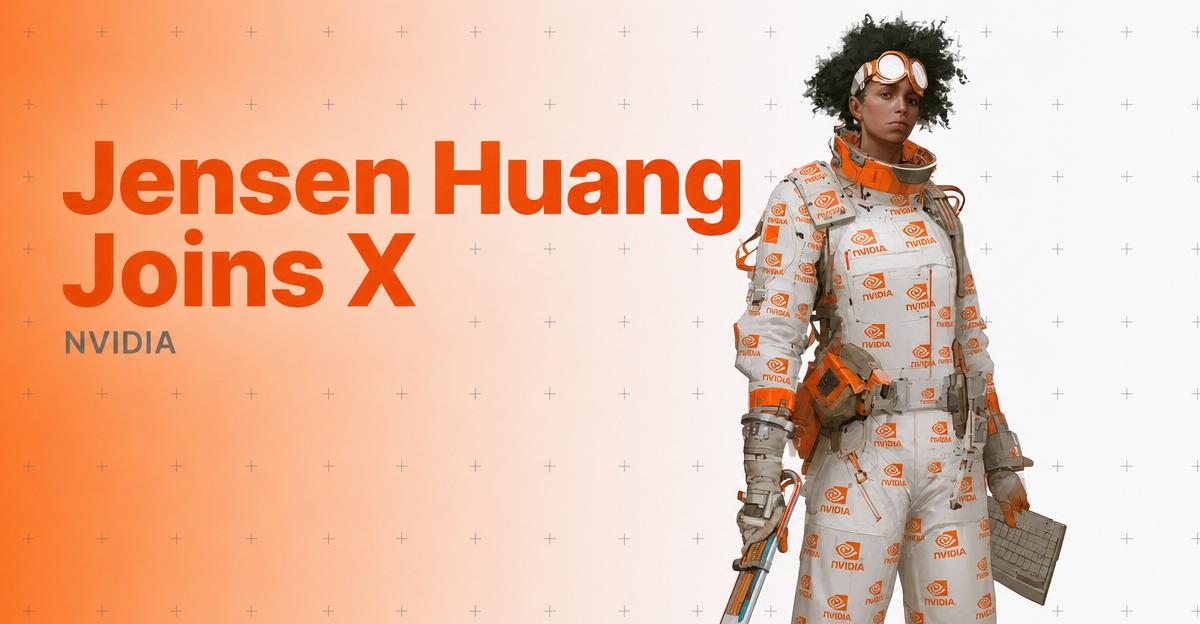
On July 24, 2026, Jensen Huang posted on X for the first time. His debut was not a product teaser or earnings preview. It was a link to a three-page letter titled "Open Weights and American AI Leadership," signed by NVIDIA and two dozen other organizations at launch, with the roster expanding to more than 70 names on Microsoft's live signatory page by July 27.
This article reconstructs Huang's public-record position from that post, the letter text NVIDIA hosted, and subsequent endorsements from Satya Nadella and Sundar Pichai. Classy AI News did not conduct an independent interview.

The first post
Huang summarized the letter in four lines that traveled far beyond semiconductor circles:
AI will transform every industry, power every company, and be built by every country. Open models strengthen safety and cybersecurity, accelerate innovation and diffusion, and enable sovereignty. The world needs both frontier closed models and frontier open models.
The diplomatic framing is deliberate. Huang is not arguing that closed frontier labs should disappear. He is arguing that American leadership will be judged by whether advanced capability diffuses into factories, hospitals, farms, and classrooms—not whether any single closed model wins a benchmark.
That distinction matters because Washington spent the same week debating a different gate: who may access OpenAI's GPT-5.6 Sol and Anthropic's Mythos 5 at all.
The 1980s parallel
The letter opens with a historical analogy. In the 1980s, Huang writes, the United States faced a choice about whether to restrict access to computing technology. Open ecosystems won, and American software diffused globally.
The coalition letter explicitly warns that premature restrictions on open-weight models would weaken U.S. competitiveness rather than strengthen national security. Signatories including Meta, Microsoft, Hugging Face, IBM, and—by July 27—OpenAI and Google argue that downloadable weights let researchers inspect models, patch vulnerabilities, and adapt systems to local infrastructure.
Huang's efficiency argument is equally central: open weights let organizations match the right model to the right job at the right cost, reserving frontier-scale compute for genuine frontier problems.

Safety as a crowd-sourced property
The letter's boldest claim is that open weights can strengthen safety and cybersecurity because inspection is distributed. Closed systems, the coalition argues, concentrate both capability and oversight in a handful of companies—creating single points of failure.
That thesis collides head-on with the week's other headline: OpenAI and Anthropic restricting their strongest cybersecurity-capable models to customers approved by the Trump administration after internal evaluations and government review.
Huang does not address that vetting process directly in the letter. But his "both" formulation—frontier closed and frontier open—implicitly rejects a world where access to every powerful model flows through a Washington approval queue.
Who signed, who stayed out
The launch PDF listed 25 organizations. By July 27, reporting tracked OpenAI and Google joining an updated logo sheet alongside NVIDIA, Meta, and Microsoft. Anthropic and Amazon remained absent—a split that has now persisted through multiple coalition iterations.
Elon Musk quote-posted Huang's debut within an hour: "This has my full support. Jensen is right." Mark Zuckerberg echoed the competition argument on his own channels. The letter's political economy is transparent: chip vendors, cloud providers, and application-layer companies all benefit when weights are portable.
Anthropic's counter-narrative—articulated publicly by CEO Dario Amodei—is that the most powerful hardware and models should remain scarce and accountable. Huang's letter treats wide distribution as resilience. Amodei treats it as risk. Both men describe national security. They disagree on whether diffusion or concentration is the safer default.
Sovereignty beyond software
In LinkedIn commentary tied to the letter, Huang extended the sovereignty argument to infrastructure: democratizing model weights is "the software half of sovereignty," but factories and hospitals still need power and cooling for the racks that run them.
That is characteristic Huang—always pulling the conversation back to physical compute. Open weights may travel freely; GPUs and energy do not. The letter's policy ask is therefore not "release everything immediately." It is "do not foreclose open weights as a strategic lane before the ecosystem matures."

What changes next
Huang's X account was created in June 2026 and crossed 200,000 followers on a single post. Whether that platform presence translates into durable policy influence depends on how Congress and the Commerce Department finalize the voluntary pre-release review framework Trump signed into executive order in June.
For now, the public record is clear: NVIDIA's CEO used his first social post not to celebrate a new chip, but to argue that American AI leadership is an ecosystem outcome—and that open weights are load-bearing infrastructure in that ecosystem.
The fracture with Anthropic is not cosmetic. It is a disagreement about whether the safest future concentrates frontier capability or distributes it. Huang bet his debut on diffusion.
### Sources
- NVIDIA — Open Weights and American AI Leadership (PDF) (July 24, 2026)
- Workman Labs — Jensen Huang Joins X, and His First Post Is a Bet on Open Models (July 24, 2026)
- ExplainX — Open Weights and American AI Leadership Letter (July 27, 2026)
- Benzinga — Sundar Pichai Backs Jensen Huang's Open-Weight AI Push (July 27, 2026)
- The Next Web — Sam Altman Renews His 'Democratic AI' Pitch as Anthropic Holds a Harder Line (July 2026)